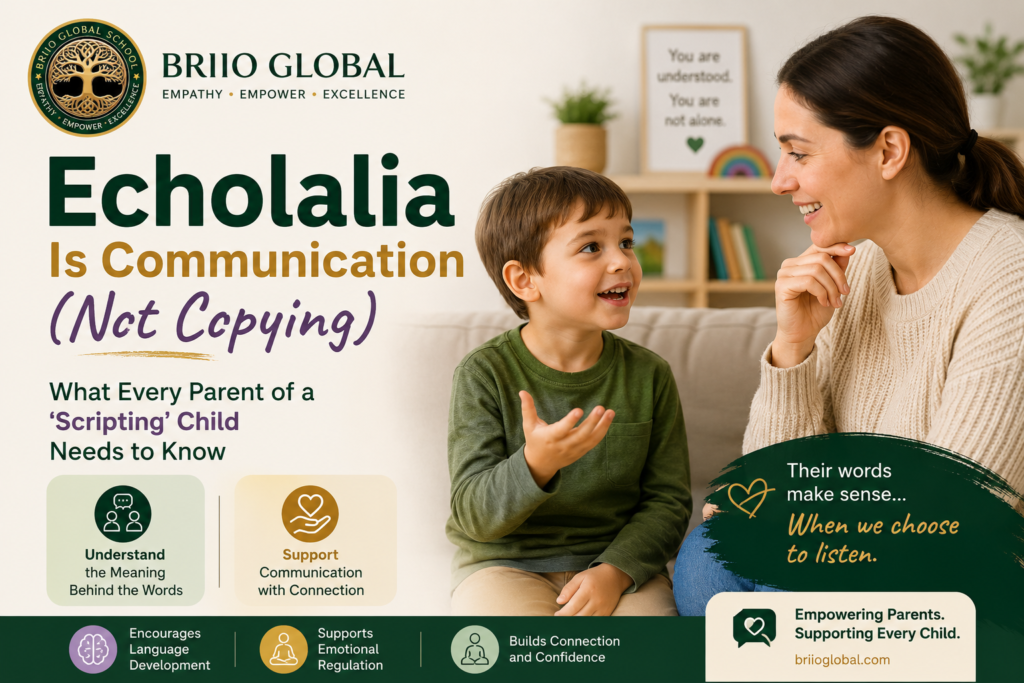
Echolalia Is Communication (Not Copying): What Every Parent of a “Scripting” Child Needs to Know
When my child first started repeating movie lines instead of answering questions directly, I panicked. If I asked, “Do you want water?” he would repeat an entire cartoon scene instead of saying yes or no. At first, people around us called it “copying.” Some even suggested he wasn’t truly understanding language at all. But the more I observed him closely, the more I realized something important:
He wasn’t repeating words randomly. He was communicating the best way he knew how. That realization completely changed the way we supported him at home. If your child repeats phrases, scripts conversations, echoes questions, or constantly uses lines from videos, songs, or shows, you may have heard the term echolalia. And despite what many parents are told, echolalia is not meaningless.
In many neurodivergent children, especially autistic children, echolalia is actually an important stage of communication and language development.
What Is Echolalia?
Echolalia happens when a child repeats words, phrases, or sentences they’ve heard before. These phrases may come from TV shows, songs, YouTube videos, school routines, or favourite movies. Some children repeat phrases immediately, while others use memorized scripts hours or even days later in completely different situations.
To outsiders, it may sound repetitive or confusing. But often, those repeated phrases carry real meaning for the child using them. That’s why many autism and speech specialists now recognize echolalia as a valid form of communication rather than simply “copying.” The moment parents begin understanding the meaning behind the scripts instead of trying to stop them immediately, communication often becomes much easier.
The Moment Everything Changed for Us
The breakthrough came when we stopped asking:
“How do we stop the scripting?”
And started asking:
“What is our child trying to communicate through it?”
That one mindset shift completely changed the way we supported our child at home. We started noticing patterns in the phrases he used. Certain movie lines appeared during stressful situations. Some scripts showed excitement, while others were requests, emotional expressions, or attempts to connect socially. Our child wasn’t disconnected from communication. He was communicating differently and once we understood that, the pressure inside our home started disappearing.
Why Neurodivergent Children Use Scripting
Many neurodivergent children process language differently. Instead of learning communication word-by-word immediately, they often learn language in larger “chunks” or scripts first. These scripts become familiar, emotionally meaningful, and safe. A child may repeat a phrase from a cartoon because it helps them express excitement, anxiety, comfort, frustration, or connection.
The words may not always sound connected to the moment, but emotionally they often make perfect sense to the child using them. That’s why echolalia should not automatically be viewed as a problem to eliminate. In many cases, it’s actually part of how the child is learning communication and language regulation.
What Helped Our Child Most
Ironically, communication improved faster once we stopped pressuring speech so heavily. Instead of correcting every repeated phrase, we began responding to the meaning behind it. We slowed down conversations, reduced constant questioning, and created calmer communication environments at home. Most importantly, we stopped treating echolalia like something “wrong.” That emotional shift mattered more than we realized because children communicate more confidently when they feel understood instead of constantly corrected.
What helped our family most was:
- Responding calmly to scripts
- Modeling simple natural language
- Giving extra processing time
- Avoiding excessive corrections
- Celebrating all forms of communication
Slowly, communication became more flexible and natural over time.
Why Parents Need to Stop Comparing Milestones
One of the hardest parts of parenting a neurodivergent child is the constant comparison. Social media, school expectations, and developmental checklists can make parents panic when communication looks different from other children. But different does not mean broken.
Some children communicate through gestures. Some through scripting. Some through AAC devices, visuals, or delayed speech. Some eventually become highly verbal much later than expected. Communication is not one-size-fits-all. And children deserve support without being pressured to communicate exactly like everyone else.
Final Thoughts
Echolalia is not meaningless repetition. For many autistic and neurodivergent children, it is communication, connection, emotional regulation, learning, and self-expression all happening at once. The moment we stopped trying to eliminate scripting and started understanding it, our relationship with our child changed completely. Because sometimes children are not “just repeating words.” Sometimes they are trying very hard to connect with the world around them.