When “Rabbit” Becomes “Wabbit”: Understanding Gliding in Children’s Speech Development
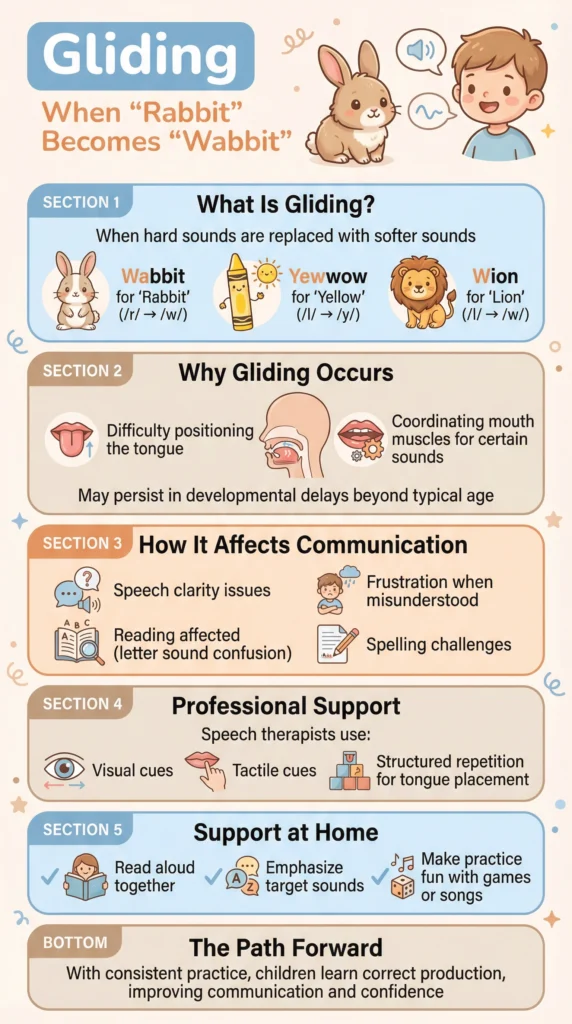
Many young children make cute speech substitutions while learning to talk, but some patterns last longer than expected. One common speech pattern is called gliding in speech development, where harder sounds like /r/ and /l/ are replaced with easier sounds like /w/ or /y/. For example, a child may say “wabbit” instead of “rabbit” or “yewwow” instead of “yellow.” While this can be typical in early childhood, persistent gliding may indicate a speech sound delay that needs attention. Gliding happens because certain sounds require precise tongue placement and strong coordination of the lips, tongue, and jaw. Sounds like /r/ and /l/ are considered more complex because the tongue must move into a specific position inside the mouth. If a child has difficulty controlling these movements, the brain may substitute a simpler sound that feels easier to produce.
In most children, gliding disappears naturally as speech skills develop. However, in children with developmental delays, oral motor weakness, or speech sound disorders, this pattern may continue beyond the expected age. When gliding persists, it can affect how clearly a child speaks and how easily others understand them. Speech clarity is important not only for communication but also for learning. Children who pronounce sounds incorrectly may confuse similar letters when learning to read and spell. Because spoken language and written language are closely connected, ongoing sound errors can influence phonics skills, reading confidence, and classroom participation.
Gliding can also affect a child emotionally. When others frequently ask them to repeat words, they may feel frustrated or embarrassed. Some children begin to avoid talking in groups or speaking in class, which can affect confidence and social interaction.
Signs That Gliding May Need Speech Support
Parents often wonder whether sound substitutions are normal or a sign that their child needs help. While occasional sound errors are part of typical development, consistent gliding after the expected age range may require evaluation.
Common signs of gliding speech errors in children include:
- Saying “wabbit” instead of “rabbit” or “yion” instead of “lion”
- Replacing /r/ and /l/ sounds with /w/ or /y/ in many words
- Speech that is difficult for unfamiliar listeners to understand
- Frustration when trying to say certain words
- Difficulty learning letter sounds during early reading
When these patterns continue past early childhood, a speech-language evaluation may help determine whether the child needs support. Specialists trained in Speech Therapy can assess how the child moves their tongue and mouth while speaking and identify which sounds need practice. Speech therapists often look at oral motor coordination, listening skills, and the child’s ability to hear the difference between correct and incorrect sounds. This process helps create a treatment plan that improves speech clarity step by step.
Activities That Help Children Correct Gliding Sounds
Improving speech sound production takes time and repetition, but practice can be fun and engaging. Children learn best through playful activities that allow them to hear and try the correct sound in a relaxed way. Consistent practice at home, along with therapy, can make a big difference.
Helpful home strategies for gliding speech sound practice include:
- Reading aloud together and emphasizing /r/ and /l/ sounds
- Playing sound games that focus on listening and repeating words
- Using mirrors so the child can see tongue and lip movement
- Singing songs or rhymes with target sounds
- Practicing short words before moving to longer ones
Speech therapists often use visual cues, tactile prompts, and structured repetition to teach proper tongue placement. Over time, the child learns how the correct sound feels and becomes more comfortable using it in everyday speech. With patience, encouragement, and regular practice, most children can learn to produce /r/ and /l/ sounds correctly. As speech becomes clearer, communication improves, and children often feel more confident speaking with family, teachers, and friends.