Turning “Shop” Into “Top”: Understanding the Stopping Speech Process in Children
Speech development in young children follows predictable patterns, but sometimes these patterns affect how clearly a child communicates. One common phonological process is Stopping (speech process), where children replace fricative sounds with stop sounds. For example, a child might say “top” instead of “shop” or “dun” instead of “sun.” Stopping is a normal part of early speech development, but if it continues beyond the typical age, it may affect speech clarity, literacy development, and a child’s confidence in communication. Understanding why stopping happens and how parents can support improvement can make a significant difference.
Why Stopping Happens in Speech Development
Stopping occurs when a child replaces continuous airflow sounds like /s/, /f/, or /sh/ with short burst sounds such as /t/, /p/, or /d/. Fricative sounds require careful control of airflow and precise tongue placement, which can be challenging for developing speech systems. Young children often choose easier sounds that require less coordination. Stop sounds are produced by briefly blocking airflow and then releasing it, making them easier for early speech learners.
Because of this, stopping may appear in words like:
- “top” for “shop”
- “tun” for “sun”
- “pan” for “fan”
While this speech pattern is common in early childhood, it typically fades as oral motor control and sound awareness improve. However, if stopping continues for too long, it may influence how children hear and process sounds in words. Persistent stopping can impact speech clarity in children, making it harder for others to understand them. It can also affect early reading and spelling skills because children may struggle to recognize the difference between similar sounds. For example, confusing /s/ with /t/ can make decoding words more difficult during literacy development. Speech-language professionals often evaluate these patterns carefully to determine whether they are developmentally appropriate or require targeted support.
Therapy Approaches and Home Practice for Reducing Stopping
Speech therapy for stopping focuses on helping children learn the difference between fricative sounds and stop sounds. Therapists use structured exercises that build sound awareness and gradually train the mouth to produce the correct airflow and tongue placement.
Common therapy techniques include:
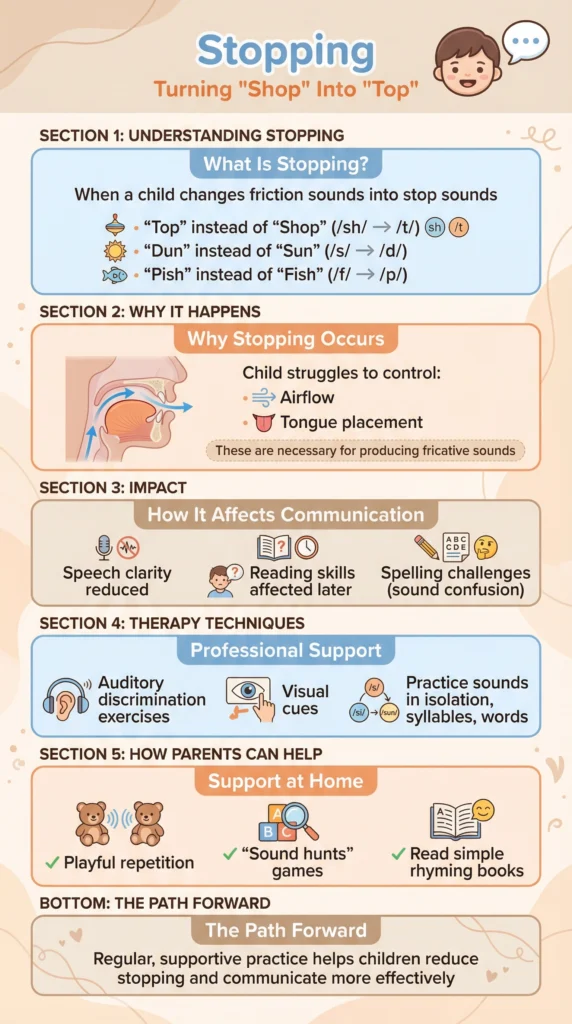
- Auditory discrimination exercises to help children hear sound differences
- Visual cues that show where airflow should occur
- Practicing target sounds in isolation before using them in words and sentences
Children often begin by practicing a sound alone, such as “ssss,” before combining it with vowels or simple words. Over time, this step-by-step approach strengthens sound control and speech accuracy. Parents also play an important role in supporting speech development at home. Simple, playful activities can reinforce therapy goals and make practice enjoyable for children.
Helpful home practice activities include:
- Playing “sound hunts” where children find objects starting with a target sound
- Reading rhyming books that repeat fricative sounds
- Encouraging slow, exaggerated pronunciation during practice
- Praising effort rather than correcting harshly
These activities help children become more aware of how sounds are produced while building confidence in speaking.
Encouraging Progress in Speech Development
Stopping is a manageable speech pattern, and many children improve significantly with consistent practice and supportive guidance. With the help of speech therapy and positive reinforcement at home, children can gradually master difficult sounds and improve overall communication. Early support not only strengthens speech clarity and phonological development in children but also supports reading readiness and social confidence. When children feel understood, they are more willing to participate in conversations, classroom activities, and storytelling. With patience, playful practice, and professional guidance when needed, children can move from saying “top” to “shop” and develop stronger, clearer speech skills for the future.