Cluster Reduction in Children: Why Dropping Sounds in Word Blends Happens and How It Affects Speech Development
Cluster reduction is a common speech pattern seen in young children, especially those with speech delays. It happens when a child drops one sound from a group of consonants in a word. For example, a child may say “top” instead of “stop” or “pay” instead of “play.” These sound groups are called consonant clusters or blends, and they require precise coordination of the lips, tongue, and airflow. While some cluster reduction is normal in very young children, it may become a concern if it continues beyond the expected age. When a child cannot produce blends clearly, their speech may be difficult to understand, which can affect communication, confidence, and social interaction. Understanding why cluster reduction happens and how to support children at home and in therapy can help improve speech clarity over time.
What Is Cluster Reduction in Speech Development and Why It Happens
Cluster reduction occurs when a child simplifies a word by leaving out one of the consonants in a blend. Consonant clusters appear in many everyday words, such as “stop,” “play,” “school,” and “train.” Saying these words correctly requires the brain to plan several movements at once and the mouth to produce them in the correct order. Young children often simplify these sounds because their speech system is still developing. Producing multiple consonants together needs strong coordination, good motor planning, and proper control of breathing and voice. Children with speech delay, motor speech difficulty, or phonological disorders may find this especially challenging.
Common examples of cluster reduction include:
- Saying “pane” instead of “plane”
- Saying “cool” instead of “school”
- Saying “tar” instead of “star”
- Saying “pay” instead of “play”
- Saying “poon” instead of “spoon”
These errors make speech shorter and easier for the child, but they also make words harder for others to understand.
How Dropping Sounds in Word Blends Affects Communication and Learning
When cluster reduction continues for a long time, it can reduce speech intelligibility, which means other people may not understand what the child is saying. This can create frustration for both the child and the listener. Children may repeat the same word many times, become upset, or stop trying to speak in longer sentences. Speech clarity is important for social interaction, especially in preschool and school settings. If classmates cannot understand the child, the child may avoid talking, playing, or answering questions. Over time, this can affect confidence and participation in learning activities. Cluster reduction can also affect reading and spelling later, because children who cannot hear and produce all sounds in a word may
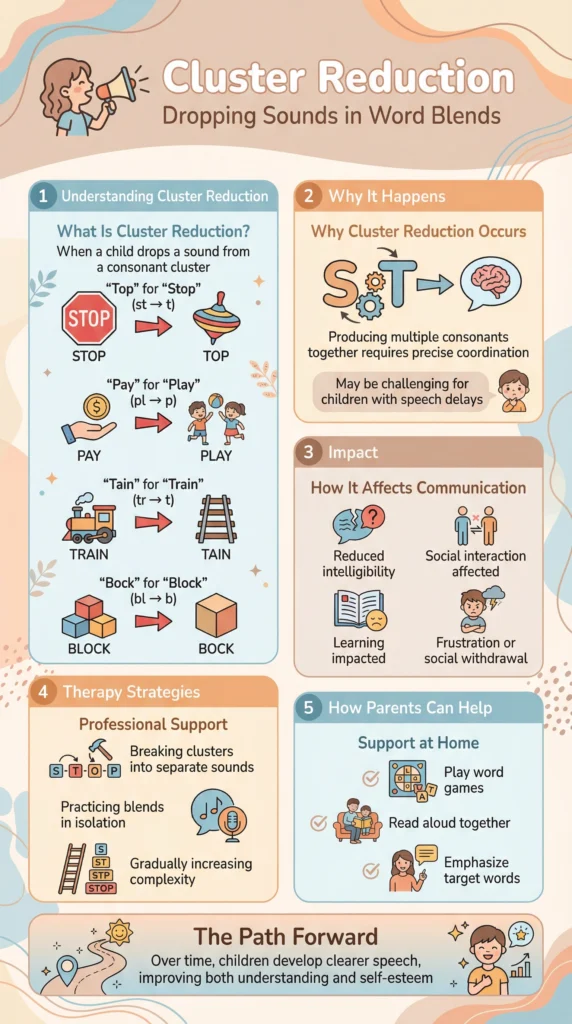
have difficulty recognizing them in written form. Early support helps prevent these problems.
Speech Therapy Techniques Used to Correct Cluster Reduction in Children
Speech therapists use step-by-step methods to help children learn how to produce blends correctly. Instead of forcing the child to say the whole word at once, therapy focuses on teaching each sound clearly and then combining them slowly. Therapy usually begins with simple blends and gradually moves to more complex words. Repetition, visual cues, and playful activities are used to help the child feel confident while practicing. Children often improve faster when therapy is combined with regular practice at home.
Helpful speech therapy and home practice strategies include:
- Breaking blends into separate sounds before joining them
- Practicing consonant clusters in short, simple words
- Using picture cards and word games for repetition
- Reading aloud and emphasizing target words
- Encouraging clear speech without correcting harshly
Consistent practice in a positive environment helps the child learn correct sound patterns naturally.
How Parents Can Support Clear Speech and Build Confidence at Home
Parents play an important role in helping children improve speech. The goal is not to pressure the child, but to give many chances to hear and practice correct sounds. Talking slowly, repeating words clearly, and using fun language games can make a big difference. Children should feel comfortable speaking, even when they make mistakes. When they notice that others understand them better, their confidence grows. Over time, clearer speech helps them participate more in conversations, school activities, and play with other children. With early speech therapy, regular practice, and patient support from parents, most children outgrow cluster reduction and develop clear, understandable speech that supports learning and social success.