Initial Consonant Deletion in Children Speech: Why Kids Skip the First Sound in Words and How It Affects Communication
Initial consonant deletion is a speech pattern where a child leaves off the first sound of a word. For example, a child may say “at” instead of “hat” or “og” instead of “dog.” This type of error can make speech difficult to understand because the beginning sound of a word is important for identifying what is being said. While some sound simplifications are normal in early speech development, initial consonant deletion is less typical and may indicate a speech delay or difficulty with sound planning. Children who show this pattern often need support to develop clearer speech and better communication skills. Understanding why this happens helps parents respond with the right strategies at home and seek help when needed.
What Is Initial Consonant Deletion and Why It Happens in Young Children
Initial consonant deletion occurs when a child omits the first sound of a word, making the word incomplete. The first sound in a word helps listeners recognize the word quickly, so when it is missing, the word can sound confusing or unclear. This pattern is often linked to oral-motor coordination difficulties or speech sound planning challenges. Producing the first sound requires the child to start the word with the correct mouth position and airflow. If the child has difficulty planning or coordinating these movements, they may skip the first sound and say the rest of the word instead. In some cases, children may not clearly hear or recognize the first sound, which can also affect how they produce it. This is why sound awareness and listening skills are important in speech development.
Common examples of initial consonant deletion include:
- Saying “at” instead of “hat”
- Saying “og” instead of “dog”
- Saying “ar” instead of “car”
- Saying “un” instead of “sun”
- Saying “all” instead of “ball”
These patterns make speech harder to understand because the most important identifying sound is missing.
How Skipping the First Sound Affects Communication and Learning Skills
The first sound of a word plays a key role in speech clarity. When it is missing, listeners may struggle to understand what the child is trying to say. This can lead to frequent misunderstandings, where the child has to repeat words multiple times. Over time, this can cause frustration and reduce the child’s willingness to communicate. Social interaction may also be affected. Children who are not easily understood may feel shy or avoid speaking in group settings.
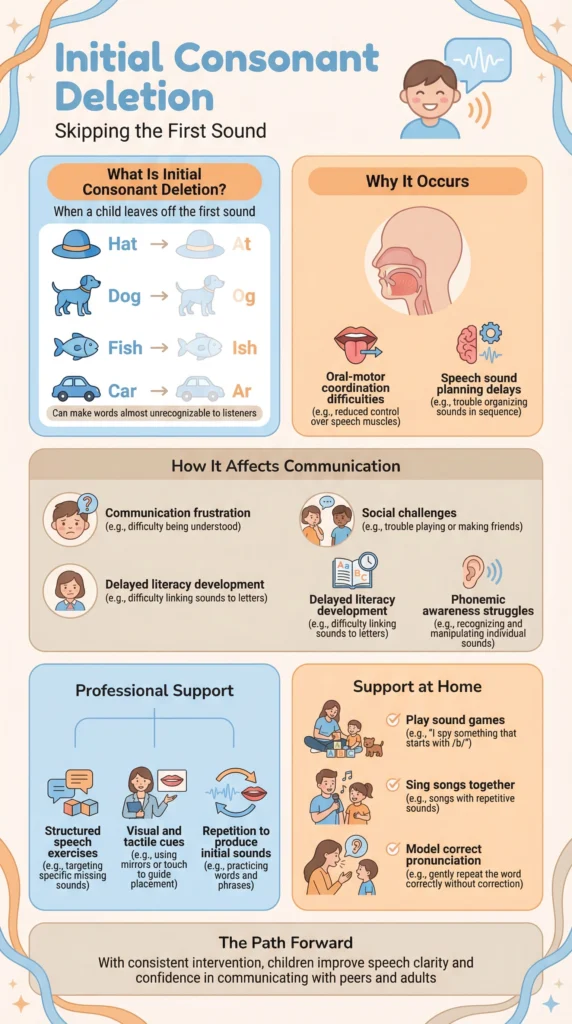
They may hesitate to answer questions or participate in conversations with peers and adults. Initial consonant deletion can also impact early literacy skills. Learning to read and spell requires understanding how sounds match with letters. If a child cannot hear or produce the first sound, they may struggle with phonemic awareness, which is the ability to identify and manipulate sounds in words. This can make reading and writing more challenging as the child grows. Early support is important to help children build strong speech and language skills.
Speech Therapy Techniques Used to Correct Initial Consonant Deletion
Speech therapists use structured and engaging methods to help children produce the first sound in words. Therapy often begins with helping the child hear and recognize the missing sound. This may include listening activities where the child learns to identify differences between words. Once the child becomes aware of the sound, practice focuses on producing it correctly. Therapists may use visual cues, such as showing mouth movements, or tactile cues, such as guiding airflow, to help the child understand how to start the word. Practice usually begins with simple words and gradually moves to longer words and sentences.
Common therapy and home practice techniques include:
- Practicing simple words with clear starting sounds
- Using visual cues to show mouth positioning
- Playing sound matching and listening games
- Singing songs and rhymes that emphasize sounds
- Repeating words in a slow and clear manner
These strategies help the child develop better control and awareness of speech sounds.
How Parents Can Support Speech Development and Build Confidence at Home
Parents play an important role in helping children improve their speech. Modelling correct pronunciation during everyday conversation is one of the most effective ways to support learning. Instead of correcting the child directly, parents can repeat the word correctly so the child hears the proper form. For example, if the child says “og” the parent can respond with “Yes, dog,” emphasizing the first sound naturally. This approach reduces pressure and encourages learning through listening. With consistent practice, patience, and support, most children improve their speech clarity over time. As they learn to produce the first sound correctly, communication becomes easier, confidence grows, and they are better able to interact with others in daily life.