Challenges in Ball Throwing in Children: Why Accurate Throwing Skills Do Not Develop Easily for Every Child
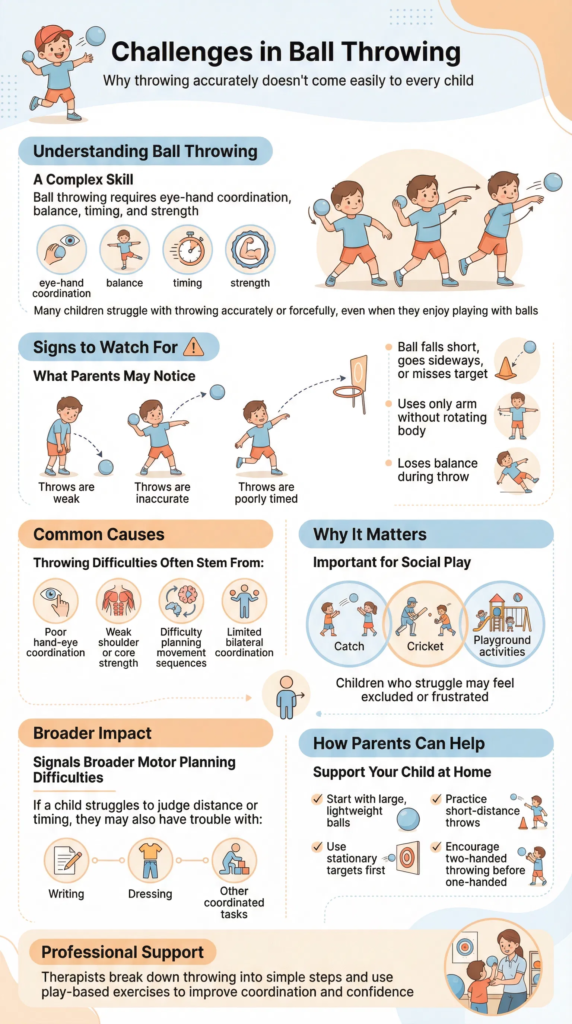
Ball throwing is an essential skill in childhood that supports play, sports, and overall motor development. While it may seem simple, throwing a ball accurately and with enough force actually requires a combination of skills such as eye-hand coordination, balance, timing, strength, and motor planning. Many children enjoy playing with balls but still struggle to throw properly, which can affect both their confidence and participation in group activities. Parents often notice that their child’s throws are weak, inaccurate, or inconsistent. The ball may fall short, go in the wrong direction, or miss the target completely. Some children throw using only their arm without involving their body, while others lose balance during the action. These signs can indicate that the child is still developing the coordination needed for effective throwing. Understanding the reasons behind these challenges helps parents provide the right support without pressure.
Why Ball Throwing Is an Important Developmental Skill for Coordination and Play
Throwing is a complex motor activity that requires multiple parts of the body to work together smoothly. The child needs to look at the target, judge distance, plan the movement, and then coordinate the arms, shoulders, and core muscles to release the ball at the right time. When children develop throwing skills, they are also improving their coordination, balance, and body awareness. These skills are important not only for sports like cricket or catch but also for daily tasks that require controlled movements. Throwing helps build confidence because it allows children to participate in group games and playground activities. Developing this skill also supports other areas of learning. For example, the ability to coordinate movements and control timing is important for writing, dressing, and other fine and gross motor tasks.
Common Reasons Why Some Children Struggle with Ball Throwing Accuracy
Children who have difficulty throwing often face challenges in coordinating their body movements. Throwing is not just about moving the arm. It involves shifting weight, rotating the body, and timing the release of the ball correctly. If any part of this sequence is weak, the throw may not be accurate or strong.
Several factors can affect throwing ability:
- Poor hand-eye coordination, making it hard to aim
- Weak shoulder or core muscles, reducing power
- Difficulty planning movement sequences
- Limited bilateral coordination between both sides of the body
- Trouble maintaining balance during movement
Some children may throw without stepping forward, while others may not rotate their body properly. This makes the throw less controlled and less powerful.
These challenges are not signs of laziness but indicators that the child needs more practice and support in developing motor skills.
How Throwing Difficulties Can Affect Play, Confidence, and Social Interaction
Throwing is a key part of many childhood games, including catch, cricket, and playground activities. When a child struggles with this skill, they may feel left out or frustrated during group play. Other children may not understand the difficulty, which can affect social interaction. Over time, the child may avoid games that involve throwing or catching. This avoidance can reduce opportunities to practice and improve, leading to slower development of coordination and strength. It can also affect confidence, as the child may compare themselves with peers who perform better. Throwing challenges may also be linked to broader motor planning difficulties. If a child finds it hard to judge distance or timing, they may also struggle with tasks like writing, buttoning clothes, or using tools. Early support can help improve these skills and boost confidence.
Simple Ways Parents Can Help Improve Ball Throwing Skills at Home
Parents can support their child’s development by making practice fun and pressure-free. Children learn best through play, so activities should focus on enjoyment rather than perfection.
Helpful ways to practice throwing include:
- Start with large, lightweight balls that are easy to handle
- Practice throwing over short distances first
- Use stationary targets like a bucket or wall
- Encourage two-handed throwing before moving to one hand
- Praise effort and progress instead of accuracy
These activities help build strength, coordination, and confidence gradually.
When to Seek Professional Support for Throwing Difficulties
If a child continues to struggle with throwing despite regular practice, or shows difficulty with other coordination tasks, professional support may be helpful. Occupational therapists and physical therapists can assess motor skills and identify specific areas that need improvement. Therapists use play-based exercises to break down throwing into simple steps. They focus on improving strength, coordination, balance, and motor planning in a structured way. With the right guidance, most children improve their throwing skills and gain confidence in participating in sports and play. Supporting children early helps them enjoy physical activities, build friendships, and develop essential life skills.