Final Consonant Deletion in Children Speech Development: Why Kids Leave Off the Last Sound in Words
Final consonant deletion is a common speech pattern seen in young children, especially in early language development. It happens when a child leaves off the last sound of a word, such as saying “ca” instead of “cat” or “do” instead of “dog.” While this can be normal for toddlers who are just learning to talk, it may become a concern if the pattern continues as the child grows older. The last sound of a word plays an important role in making speech clear. When final sounds are missing, words can sound incomplete and may be difficult for others to understand. Children with speech delays often show final consonant deletion because producing the last sound requires precise control of the lips, tongue, and airflow. Understanding this pattern helps parents know how to support speech development at home and when to seek professional help.
What Is Final Consonant Deletion and Why It Happens in Young Children
Final consonant deletion occurs when a child says a word but leaves off the ending sound. For example, a child may say “pi” for “pig,” “bu” for “bus,” or “ha” for “hat.” This happens because the last sound in a word can be harder to produce than the first sound. The child must control the mouth movement and stop the airflow at the right time, which requires good coordination. In early speech development, children often simplify words to make them easier to say. As their speech muscles and sound awareness improve, they usually start producing the final sounds correctly. However, in children with speech delay or phonological disorders, this pattern may continue longer than expected.
Some common examples of final consonant deletion include:
- Saying “ca” instead of “cat”
- Saying “do” instead of “dog”
- Saying “bu” instead of “bus”
- Saying “fi” instead of “fish”
- Saying “ha” instead of “hat”
These errors make speech shorter and easier for the child, but they also reduce clarity.
How Leaving Off the Last Sound Affects Speech Clarity and Learning Skills
Final sounds help listeners understand the difference between words. For example, “cap,” “cat,” and “cab” sound very similar if the last sound is missing. When children delete final consonants, people may misunderstand what they are trying to say. This can lead to frustration, especially when the child feels they are speaking correctly but others cannot understand. Speech clarity is important for social interaction. Children who are not understood easily may become shy, speak less, or avoid talking in groups. In school, unclear speech can also affect reading and spelling because children may not notice the connection between sounds and letters.
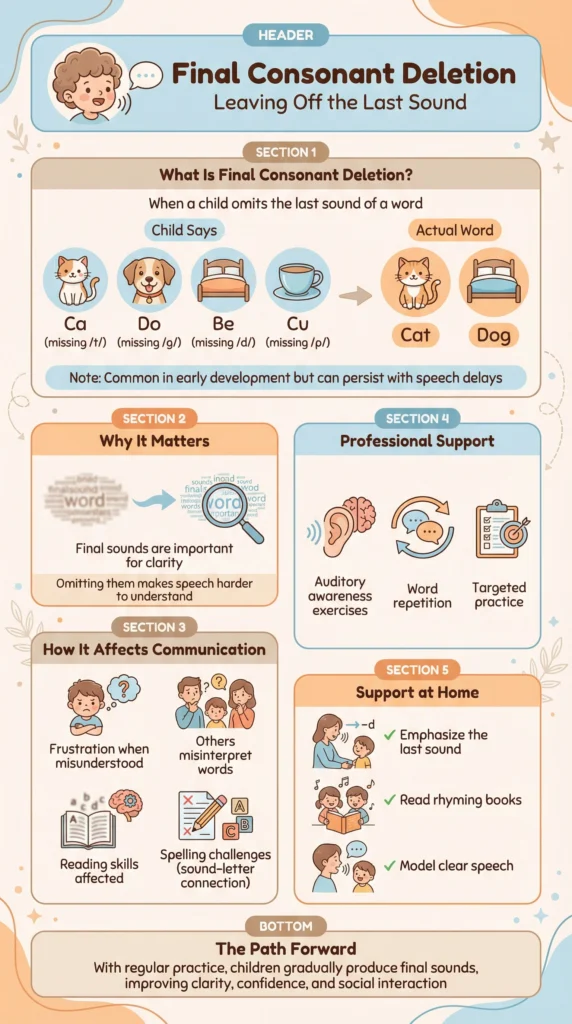
If a child does not hear or say the final sound, it can be harder to learn how words are written. Early support helps children become aware of all the sounds in a word, which improves both speaking and learning skills.
Speech Therapy Techniques Used to Correct Final Consonant Deletion
Speech therapists use structured and playful methods to help children learn to produce final sounds correctly. Therapy often begins with listening activities so the child can hear the difference between words with and without the last sound. This is called auditory awareness training. After that, the child practices saying simple words with clear ending sounds. The therapist may use pictures, games, and repetition to make practice enjoyable. As the child improves, longer words and sentences are introduced. Regular practice helps the brain learn the correct speech pattern.
Common therapy and home practice techniques include:
- Practicing words slowly with clear ending sounds
- Using rhyming words to hear sound differences
- Repeating short words with strong final consonants
- Reading aloud and emphasizing the last sound
- Encouraging clear speech without criticism
These activities help children notice and produce the final sound more consistently.
How Parents Can Support Clear Speech at Home and Build Confidence
Parents can help by speaking clearly and slightly emphasizing the last sound in words during normal conversation. For example, if the child says “ca,” the parent can respond with “Yes, cat,” so the child hears the correct form without feeling corrected. Reading books, singing rhymes, and playing word games also help children become more aware of sounds. The goal is to make practice natural and fun instead of stressful. When children feel comfortable, they are more willing to try new sounds. With regular practice and support, most children gradually learn to produce final consonants correctly. As speech becomes clearer, their confidence grows, communication improves, and they are able to interact more easily with family, friends, and teachers.