The CBT Triangle Explained: How Thoughts, Feelings, and Behaviours Are Connected in Cognitive Behavioural Therapy
Cognitive Behavioural Therapy, often called CBT, is one of the most widely used psychological approaches for managing stress, anxiety, and negative thinking patterns. At the centre of CBT is a simple but powerful concept known as the CBT Triangle. This model explains how thoughts, feelings, and behaviours are closely connected. When one-part changes, the other two also change. Many people believe that emotions come directly from situations. For example, someone may think they feel anxious because of an exam or upset because of a disagreement. However, CBT teaches that thoughts come first. The way we interpret a situation affects how we feel, and those feelings influence how we behave. Understanding the CBT Triangle helps people recognize their patterns and learn how to respond in healthier and more productive ways.
What Is the CBT Triangle and Why It Is Important for Emotional Control
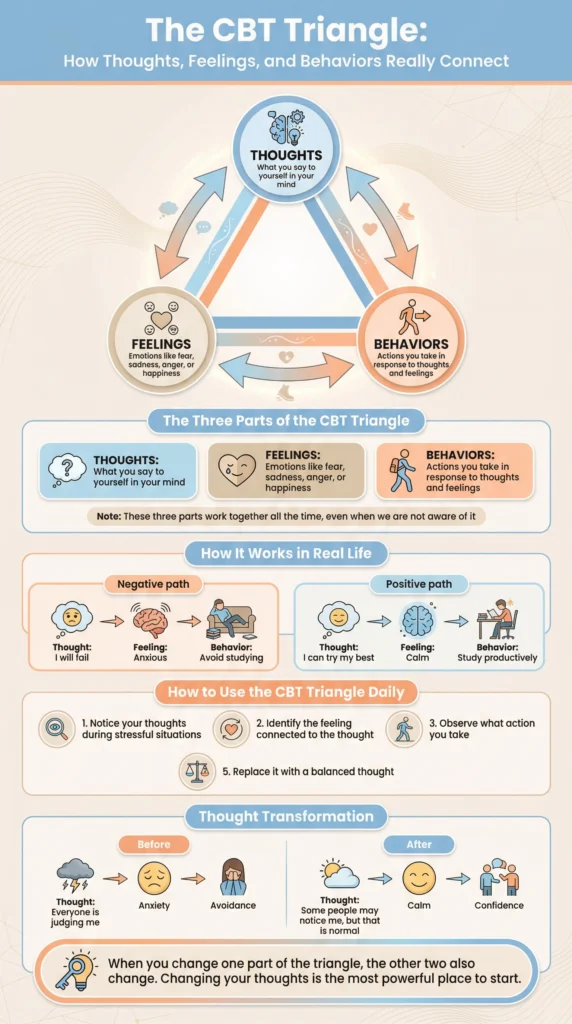
The CBT Triangle is a simple model that shows the relationship between thoughts, feelings, and behaviours. These three parts are always working together, even when we are not aware of them. A change in one part can influence the other two, which means that improving our thinking can also improve our emotions and actions. For example, imagine a student thinking, “I will fail this exam.” This thought may create fear or anxiety. Because of this feeling, the student may avoid studying or procrastinate. The behaviour then increases the chance of doing poorly, which makes the negative thought feel true. This cycle continues unless the thought changes.
The three parts of the CBT Triangle include:
- Thoughts – The words or ideas you say to yourself in your mind
- Feelings – Emotions such as fear, sadness, anger, happiness, or worry
- Behaviours – The actions you take because of your thoughts and feelings
These three elements influence each other constantly. When thoughts are negative, feelings often become uncomfortable, and behaviours may become unhelpful. CBT focuses on changing thoughts first because thoughts are the easiest part to notice and adjust.
How Negative Thinking Patterns Create Stress, Anxiety, and Avoidance
Negative thoughts can happen automatically, especially during stressful situations. The brain tries to protect us by predicting problems, but sometimes these predictions become exaggerated or unrealistic. When the mind expects failure, rejection, or danger, the body reacts with anxiety, fear, or sadness. For example, if someone thinks, “Everyone is judging me,” they may feel nervous in social situations and avoid talking to others. Avoidance may give temporary relief, but it keeps the fear strong. Over time, this pattern can affect confidence, relationships, and performance in school or work. CBT helps people understand that situations do not control emotions directly. Instead, the meaning we give to the situation creates the emotional reaction.
When we learn to question our thoughts, we gain more control over how we feel and act. This understanding is powerful because it shows that change is possible even when the situation cannot be changed.
How to Use the CBT Triangle in Daily Life to Change Negative Reactions
The CBT Triangle can be used in everyday life to handle stress, fear, and self-doubt. The first step is to become aware of what you are thinking in a difficult moment. Many thoughts happen quickly, so practice is needed to notice them. Once you identify the thought, you can check whether it is realistic or helpful. Often, negative thoughts are extreme or one-sided. Replacing them with balanced thoughts can change both emotions and behaviour.
Simple steps to practice the CBT Triangle include:
- Notice your thoughts during stressful situations
- Identify the feeling connected to the thought
- Observe what action you take because of that feeling
- Ask yourself if the thought is completely true
- Replace the thought with a more balanced and helpful one
For example, instead of thinking, “I will fail this,” you can think, “I can prepare and try my best.” This small change reduces anxiety and makes it easier to take positive action.
Why the CBT Triangle Is a Powerful Tool for Confidence, Stress Management, and Mental Health
The strength of the CBT Triangle is its simplicity. It helps people understand why they react the way they do and shows that change does not always require changing the situation. By working on thoughts, emotions and behaviours begin to shift naturally. With regular practice, the brain learns healthier thinking patterns. People become calmer in stressful situations, more confident in their abilities, and more willing to take positive action. The CBT Triangle can be used in school, work, relationships, and daily life, making it one of the most useful tools for emotional well-being.