Difficulty with Jumping in Young Children: Why Not Jumping with Both Feet Can Affect Motor Development
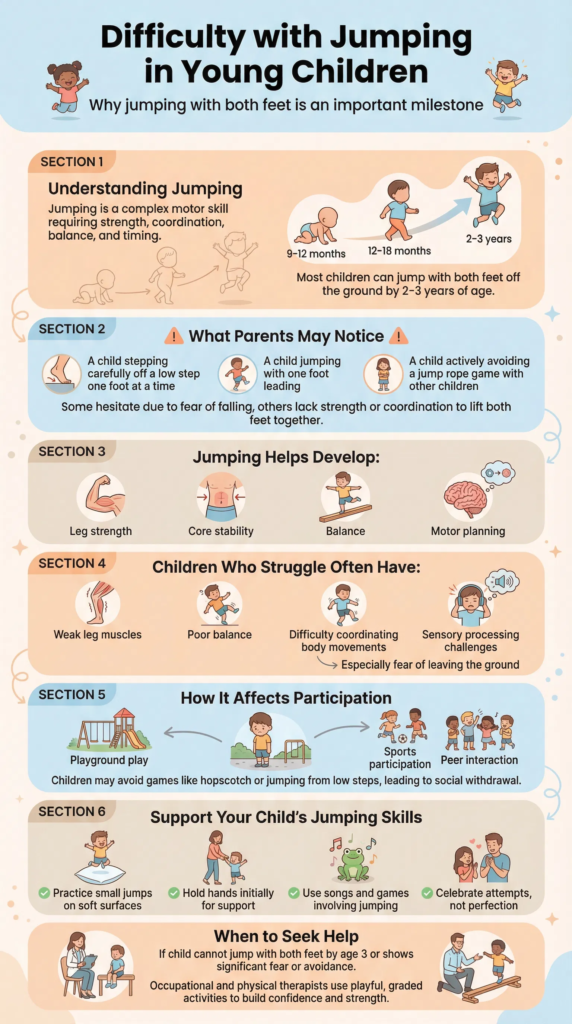
Jumping with both feet is an important motor milestone in early childhood. It may look like a simple action, but jumping actually requires strength, coordination, balance, timing, and confidence. Most children learn to jump with both feet leaving the ground between 2 and 3 years of age. When a child has difficulty jumping, it can affect not only physical development but also confidence, play skills, and social participation. Parents often notice that their child steps down instead of jumping, jumps with one foot only, or avoids games that involve jumping. Some children seem afraid to leave the ground, while others try but cannot lift both feet together. These signs can indicate weakness, coordination difficulty, or sensory processing challenges rather than laziness or lack of interest.
Why Jumping with Both Feet Is an Important Developmental Milestone in Early Childhood
Jumping is considered a complex gross motor skill because many parts of the body must work together at the same time. The child needs strong leg muscles to push off the ground, a stable core to keep the body balanced, and proper timing to land safely. The brain also has to plan the movement correctly, which is called motor planning. When children practice jumping, they are not only learning one skill. They are building the foundation for running, climbing, playing sports, and participating in playground activities. Jumping also helps children feel confident in their body movements, which is important for overall development.
Jumping helps develop several essential physical abilities:
- Leg strength needed for running, climbing, and sports
- Core stability for posture and balance
- Balance control for safe movement
- Motor planning for coordinated actions
- Confidence in movement and play
If a child does not develop these skills at the right time, they may avoid active play and fall behind in physical development.
Common Reasons Why Some Children Struggle with Jumping
Children who have difficulty jumping often have weak leg muscles, poor balance, or trouble coordinating their body movements. Some children cannot bend their knees and push at the same time, while others cannot keep both feet together when trying to jump.
Sensory processing differences can also make jumping difficult. Some children feel unsafe when their feet leave the ground, which makes them hesitate or refuse to jump. This fear is not stubbornness. It is the child’s nervous system reacting to movement in a way that feels uncomfortable or scary. Because of these challenges, the child may avoid jumping from steps, playing hopscotch, or joining games with other children.
Over time, this can affect confidence and social interaction, especially in preschool and early school years.
How Difficulty with Jumping Can Affect Play, Confidence, and Social Skills
Jumping is part of many childhood games and playground activities. When a child cannot jump easily, they may stay away from group play or feel embarrassed in front of other children. This can lead to less physical activity and fewer opportunities to practice motor skills. Children who avoid jumping may also avoid climbing, running games, or sports. As a result, their strength and coordination may develop more slowly. This can affect self-confidence, especially when the child notices that other children can do things they cannot. Early support can make a big difference because young children learn motor skills quickly when they are given the right practice.
Simple Ways Parents Can Help Children Learn to Jump with Both Feet
Parents can help by making jumping practice fun and safe. Children learn best through play, not pressure. Soft surfaces, holding hands, and using games can help the child feel secure while trying new movements.
Helpful ways to practice jumping at home include:
- Practice small jumps on soft surfaces like mats or grass
- Hold the child’s hands at first for balance and confidence
- Use songs, rhymes, or games that include jumping actions
- Encourage bending knees before jumping
- Celebrate effort and attempts instead of perfect jumping
Regular practice in a playful way helps the child build strength and confidence without fear.
When Parents Should Seek Professional Help for Jumping Difficulty
If a child cannot jump with both feet by around 3 years of age, or shows strong fear, avoidance, or poor balance, it is a good idea to seek professional advice. Occupational therapists and physical therapists can check muscle strength, balance, coordination, and sensory processing. Therapists use fun and gradual activities to help children learn jumping step by step. With early support, most children improve quickly and become more confident in play and movement.