Fronting in Children – When “Cat” Becomes “Tat”
Fronting in children is a common speech sound error where a child replaces back sounds with front sounds. For example, a child may say “tat” instead of “cat” or “do” instead of “go.” This pattern is a typical part of early speech development, especially in toddlers. However, when fronting persists beyond the expected age, it may indicate a speech development delay or articulation disorder. Fronting happens because certain speech sounds require precise tongue placement that young children are still learning to control. Sounds like /k/ and /g/ are produced at the back of the mouth. If a child has difficulty coordinating tongue movement or speech sound planning, they may substitute these sounds with easier front sounds like /t/ and /d/. As a result, “cat” becomes “tat,” and “go” becomes “do.” While this may seem minor, persistent fronting in children can affect overall speech intelligibility. When speech is unclear, others may struggle to understand the child. This can lead to frustration, repeated corrections, or withdrawal from conversations. Over time, communication challenges may also impact social confidence, especially in preschool or early school settings where peer interaction increases.
Signs of Fronting in Speech Development
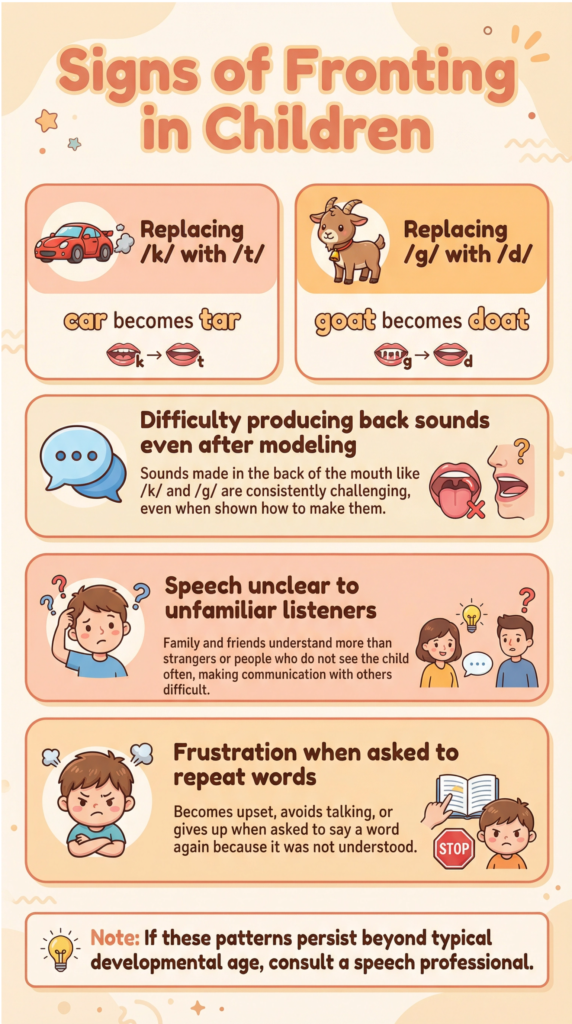
Parents may notice consistent sound substitutions in everyday speech. Common indicators include:
- Replacing /k/ with /t/ (e.g., “tar” for “car”)
- Replacing /g/ with /d/ (e.g., “doat” for “goat”)
- Difficulty producing back sounds even after modelling
- Speech that is unclear to unfamiliar listeners
- Frustration when asked to repeat words
If these patterns continue beyond the typical developmental age range, it may be beneficial to monitor progress or consult a professional. Fronting is often linked to immature oral motor coordination or delayed phonological development. Some children simply need more time and practice to refine their tongue placement skills. Others may benefit from structured support to correct persistent speech sound errors.
How Parents Can Support Speech Sound Development
Early support at home can make a meaningful difference. Parents can encourage clearer speech through simple and consistent strategies:
- Model correct pronunciation naturally without forcing repetition
- Emphasize back sounds during play (e.g., “car,” “cow,” “go,” “game”)
- Read books that highlight /k/ and /g/ sounds
- Encourage slow and clear speech during conversation
- Provide positive reinforcement for correct attempts
It is important to keep practice playful and pressure-free. Overcorrection can increase anxiety and reduce willingness to speak. If fronting in children continues or significantly affects communication, speech therapy for kids can provide structured guidance. Speech therapists use techniques such as tongue placement exercises, auditory discrimination activities, and repetitive sound practice to improve articulation. With professional support, children gradually learn to produce back sounds accurately and consistently.
Conclusion
Fronting is a common speech sound pattern in early childhood, but persistent errors may impact communication and confidence. With patience, consistent modelling, and, when necessary, speech therapy intervention, children can improve speech intelligibility and develop clearer communication skills. Early attention ensures better outcomes and supports strong language development.